A spine fracture can range from a stable compression injury that heals with protection and guided movement to an unstable fracture that threatens the spinal cord or nerve roots. You will learn how to recognise an emergency, understand the scans doctors order, compare non-surgical and surgical treatments, and prepare for an appropriate spine-care pathway in Jaipur.
Key takeaways
- Seek emergency care for weakness, numbness, bladder changes, or an unstable injury.
- MRI and CT scans reveal nerve damage, bone fragments, and spinal instability.
- Stable compression fractures may improve with medication, activity changes, and a brace.
- Surgery or vertebral augmentation depends on instability, nerve pressure, pain, and healing progress.
Which spine fractures are emergencies?
Spine fracture classification helps identify risk, but symptoms decide urgency. A compression fracture collapses the front of a vertebra and often causes sudden, localised pain. A burst fracture can break bone in several directions; a flexion-distraction injury, also called a Chance fracture, splits the spine through its supporting structures. A fracture-dislocation is especially unstable.
Any of these in the cervical, thoracic, or lumbar spine becomes an emergency with weakness, numbness, loss of bladder or bowel control, inability to walk, deformity, or worsening pain. Breathing difficulty after a neck injury demands immediate help. A minor fall can also cause a three-column fracture in a rigid, fused spine from ankylosing spondylitis.
| Pattern | Concerning clue | Action |
|---|---|---|
| Compression fracture | Sudden severe pain after a fall, especially with osteoporosis | Urgent assessment; emergency care for neurological symptoms |
| Burst fracture | High-energy impact, severe mid-back pain, leg symptoms, or deformity | Call emergency services |
| Flexion-distraction injury (Chance fracture) | Seat-belt injury or forceful forward bending | Treat as unstable; do not move the person |
| Fracture-dislocation | Visible displacement, abnormal posture, or inability to move | Immediate emergency care |
- Call emergency services; do not drive the injured person unless professionals cannot reach them.
- Keep the person still, with the head and neck aligned; prevent twisting or sitting them up.
- Do not straighten the spine or remove a helmet.
- If breathing stops, follow emergency-operator instructions and maintain spinal alignment while providing life-saving aid.
How doctors confirm the fracture and assess nerve damage
Spinal fracture diagnosis starts with a neurological examination, but examination alone cannot show the bone injury. The clinician checks strength, sensation, reflexes, limb coordination, walking ability, and bladder or bowel function. A normal result does not exclude a significant fracture or a developing compression injury.
- X-ray shows gross alignment, vertebral collapse, and some obvious fractures. It can miss small, nondisplaced, upper-spine, and three-column injuries, so a normal X-ray is not enough after a high-risk impact or marked spinal tenderness.
- A CT scan defines the fracture lines, bone fragments, posterior-element injury, spinal-canal narrowing, dislocation, and alignment. It is usually the key test for mapping the injury and planning treatment.
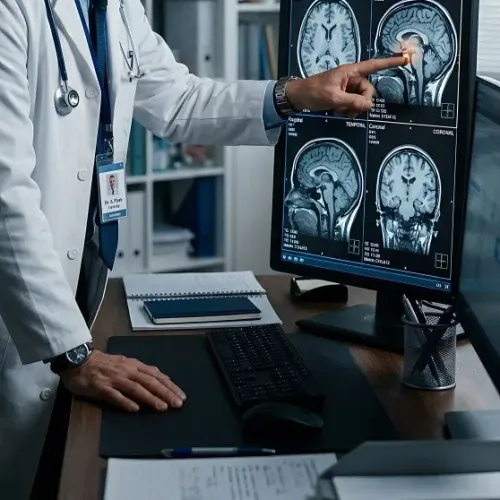
- MRI shows the spinal cord, nerve roots, discs, ligaments, epidural blood collection, swelling, and other soft-tissue damage. MRI is the appropriate test when weakness, numbness, or other neurological abnormality suggests spinal cord injury, even after CT appears reassuring.
- The neurological examination records what the nerves are doing; it does not replace imaging. CT also cannot reliably show cord or ligament damage.
One test is insufficient when the result does not explain the symptoms or the injury risk. In a person with ankylosing spondylitis or another rigid, fused spine, doctors may image the entire spine with CT because separate fractures can occur.
Add MRI when neurological findings persist or the suspected cord, root, disc, or ligament injury remains unexplained.
When rest, medication, and a brace are enough
A stable, nondisplaced fracture with normal strength and sensation, limited deformity, and preserved spinal alignment can often receive non-surgical spine fracture treatment. Doctors may use pain medicines, activity modification, and guided mobilisation instead of an operation.
| Finding | Supports treatment without surgery | Requires reassessment |
|---|---|---|
| Alignment | Vertebra remains aligned on imaging | Increasing collapse, angulation, or displacement |
| Nerves | No weakness, numbness, or bladder changes | New or worsening neurological symptoms |
| Stability | Ligaments and supporting structures remain intact | Suspected ligament disruption or instability |
| Support | Pain and posture improve with treatment | Pain remains severe despite treatment |
Recovery does not mean staying in bed until the pain disappears. Follow the prescribed walking limits, use a cervical collar for a neck fracture or a thoracolumbosacral orthosis TLSO brace for selected thoracic or lumbar injuries, and attend repeat examinations or imaging. Physiotherapy then rebuilds safe movement and strength.
Call the treating team promptly if:
- Pain increases sharply or prevents standing and walking.
- The brace causes pressure sores, breathing difficulty, or worsening pain.
- Numbness, tingling, weakness, or clumsiness appears in an arm or leg.
- You lose bladder or bowel control.
- Follow-up imaging shows further collapse or deformity.
A vertebral compression fracture also warrants bone-health assessment, including osteoporosis testing, fall-risk reduction, and treatment when fracture risk is high. Repeated fractures or failure to maintain alignment can change the plan from observation to surgical review.
When surgery or vertebral augmentation becomes reasonable
Spine fracture surgery becomes reasonable when the spine is unstable, alignment is worsening, or a compressed cord or nerve is threatened. Doctors also weigh pain, bone strength, fracture shape, neurological findings, and whether a brace can hold the spine safely.
| Option | What it does | When it becomes reasonable |
|---|---|---|
| Observation | Uses pain control, activity changes, bracing, and guided movement | The fracture is stable, nondisplaced, neurologically intact, and remains aligned |
| Vertebroplasty | Injects bone cement into a collapsed vertebral body | Severe, persistent pain matches imaging findings after non-surgical treatment fails; routine use is not recommended by NICE |
| Kyphoplasty | Expands a cavity before injecting cement and can improve vertebral height | A selected painful osteoporotic compression fracture has persistent symptoms and suitable anatomy |
| Minimally invasive pedicle screw fixation | Stabilizes unstable vertebrae through small incisions and screws | Alignment is threatened, but the fracture pattern and bone quality allow indirect stabilization |
| More extensive surgery | Decompresses nerves, rebuilds the front or back of the spine, or combines approaches | Major collapse, deformity, dislocation, posterior ligament damage, poor bone quality, infection, or direct decompression needs make limited fixation inadequate |
Cord or nerve compression, worsening weakness or numbness, major translation, and progressive angulation raise the urgency. Surgery aims to prevent further injury, restore alignment, and create a stable spine for rehabilitation; it cannot reliably reverse permanently damaged nerves.
A painful compression fracture also requires osteoporosis assessment, including fall-risk review and bone-strength treatment when indicated. A cement procedure without fracture-risk management leaves the next fracture unaddressed.
Choosing specialist care and protecting recovery in Jaipur
Ask the specialist what must happen today, what can wait, and what could worsen without treatment. In suspected spinal cord compression, ask who will manage immobilisation, breathing, circulation, pressure-injury prevention, and blood-clot prevention while imaging and surgical decisions proceed. Routine high-dose methylprednisolone is not universally recommended in emergency care.
Ask these questions during spine fracture treatment Jaipur:
- Does the scan show instability, ligament disruption, dislocation, or nerve compression?
- If I have ankylosing spondylitis spine fracture, do I need whole-spine CT, MRI, or longer-segment stabilisation?
- What neurological changes require an immediate return to the emergency department?
- When can I stand, walk, drive, lift, bend, and begin physiotherapy?
- What is the follow-up schedule for alignment, wound healing, pain, strength, and walking progress?
| Situation | Ask the specialist | Why it matters |
|---|---|---|
| Cord or nerve compression | Is decompression urgent, and what function is surgery intended to protect? | Surgery prevents further injury but cannot reliably restore an irreversibly damaged nerve. |
| Ankylosing spondylitis fracture | Could this be an unstable three-column injury despite modest pain or a normal first X-ray? | Rigid, brittle spinal segments can fracture after low-energy trauma. |
| Stable fracture | Which brace, movement limits, and warning signs apply? | Excessive rest causes weakness; unprotected movement can worsen alignment. |
| After a compression fracture | What osteoporosis assessment and fall review do I need? | Treating bone fragility reduces the risk of another fracture. |
A Jaipur consultation with Dr. Deepak Bariya should include a written rehabilitation plan and bone-health review: calcium and vitamin D intake, resistance and balance exercise, home fall hazards, and prescription osteoporosis medication when fracture risk warrants it.
Related services
Spine problems can severely affect your mobility, posture, and overall quality of life. View service → |
Head And Spine Injury Treatment Head and spine injuries are medical emergencies that require immediate attention and expert care. View service → |
Frequently asked questions
Which spine fractures are emergencies?
Fracture-dislocations, unstable burst fractures, and injuries with weakness, numbness, loss of coordination, or bladder and bowel changes need urgent assessment.
How do doctors confirm a spine fracture and assess nerve damage?
Doctors use a neurological examination alongside X-rays or CT scans to define the fracture. MRI can show spinal cord, nerve-root, disc, and ligament injury.
When are rest, medication, and a brace enough for a spine fracture?
Non-surgical care can suit a stable fracture without nerve compression or progressive deformity. Treatment may include prescribed pain relief, activity changes, physiotherapy, and a brace.
When is surgery or vertebral augmentation reasonable?
Surgery becomes reasonable when the spine is unstable, bone fragments threaten nerves, deformity progresses, or neurological function is affected. Vertebral augmentation may be considered for selected painful compression fractures.
How should you choose specialist spine fracture care in Jaipur?
Choose a specialist team that can review CT or MRI findings, perform neurological assessments, explain non-surgical and surgical options, and coordinate follow-up during recovery.
Related services
Endoscopic Spine Surgery( Slip Disc Surgery) What Is Endoscopic Spine Surgery? Endoscopic spine surgery is a minimally invasive procedure performed using a small endoscope—a thin tube with a... View service → |
Headache And Back Ache Minimally Invasive Brain & Spine Surgery ₹500 What Is Minimally Invasive Brain & Spine Surgery? Minimally Invasive Brain & Spine Surgery (MIS) involves performing surgical procedures through very... View service → |